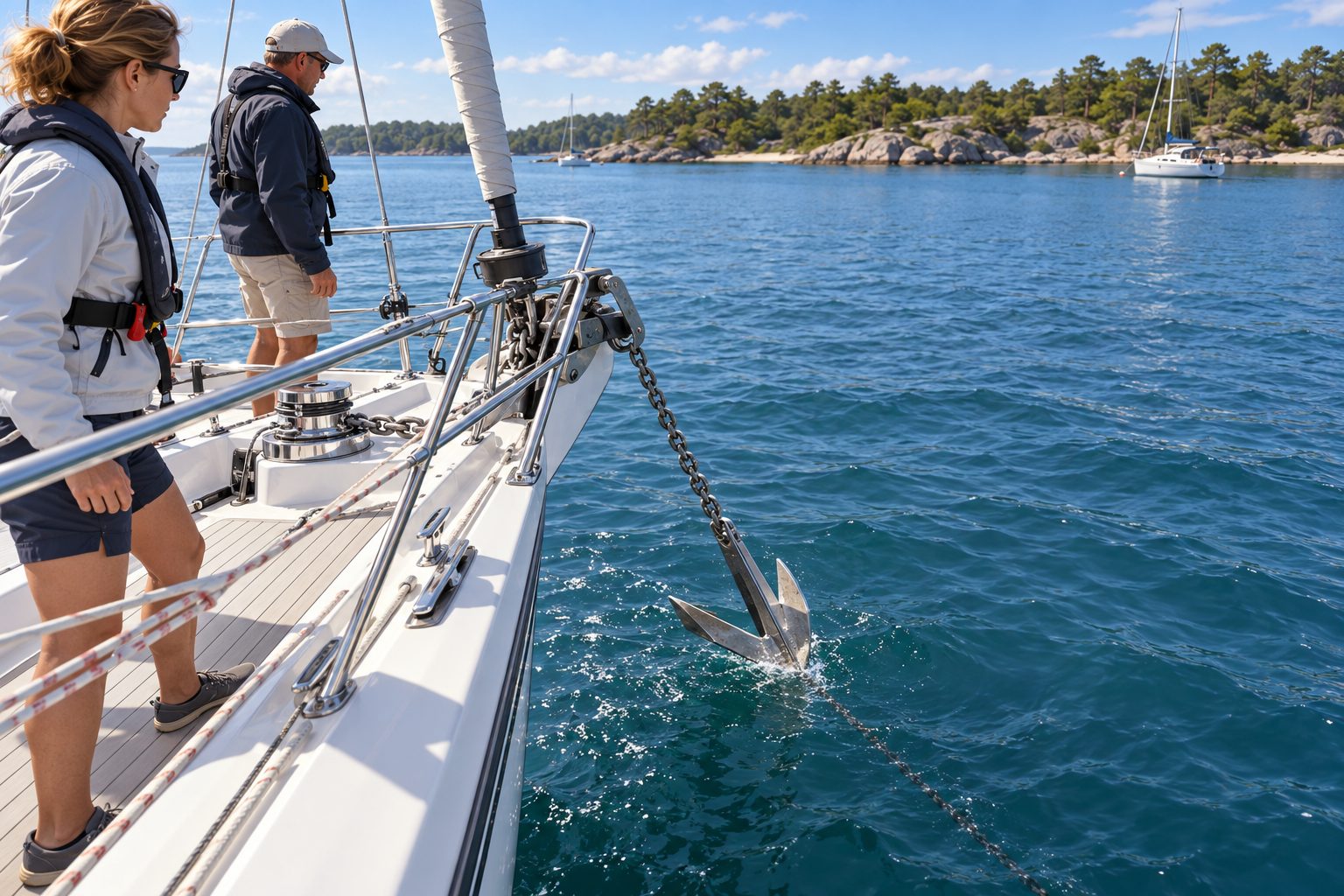
Sailing equipment and ownership
Sailboat Anchor Windlass Buying Guide
A practical guide to sailboat anchor windlass buying guide, with key considerations, maintenance advice and buyer questions. Consider your boat's specifications, operating conditions and manufacturer instructions.
Horizontal versus vertical windlasses
Horizontal and vertical windlasses differ in deck footprint, chain handling and motor placement.

Sizing and chain compatibility
Select a model using manufacturer guidance for anchor and rode loads, not only boat length.
Electrical load and wiring
Windlasses draw high current. Cable sizing, overcurrent protection and battery placement require careful design.
Installation and deck reinforcement
Check mounting structure, backing plates, water sealing and the chain's path into the locker.
Maintenance and backup
Inspect gypsy wear, electrical terminals and corrosion. Know how to retrieve the anchor if the windlass fails.
DETAILED GUIDE · 4 MIN READ
Sailboat Windlass Buying Guide: decisions, examples and a working checklist
Choose a windlass by the complete anchor-and-rode arrangement, installation geometry, electrical supply and the crew's operating routine. A prominent maximum-pull number is not a complete selection method. Have the supplier assess the boat and specify compatible components, mounting, protection and operating requirements before comparing installed prices.
Inventory the equipment the windlass must handle
Record anchor, chain and rope details as applicable, including exact chain specification and any existing gypsy identification. Measure relevant spaces and photograph the bow arrangement. Ask the supplier what further information is needed for selection rather than assuming boat length provides a complete answer.
Clarify the intended role and operating limits from the proposed unit's instructions. Do not treat the windlass as a universal towing or load-holding device. Identify the additional arrangements required for the boat's ground tackle and have them included in the proposal. The purchase should support a coherent anchoring system, not just replace a motor on the foredeck.
Compare installation geometry and access
Discuss horizontal and vertical arrangements in the context of the actual deck and locker. Ask about chain entry, available fall, drainage and access to service components. The relevant dimensions should come from the manufacturer and a boat-specific assessment rather than a general diagram for a different installation.
Have the deck structure and mounting requirements evaluated by a qualified installer. A new unit covering the old bolt holes does not establish that the support is appropriate. Ask how the installation affects locker use, foredeck movement and future removal. Include repairs to existing structure separately if they are needed before the new equipment can be fitted.
Review electrical supply and control arrangements
Provide the installer with battery-system information and proposed cable routes. Have operating requirements, protection, switching and connections designed for the selected unit and installation. Do not infer an appropriate cable or fuse size from another owner's equipment of similar appearance. The complete circuit needs a qualified assessment.
Compare control positions and how the operator can observe the rode. Discuss the specified isolation and malfunction procedures and any manual operation available for the model. Keep hands, clothing and loose equipment clear of moving machinery; practical instruction should use the manufacturer's procedures and suitable conditions, not an improvised demonstration under load.
Compare complete ownership costs
Request separate quote lines for the windlass, compatible gypsy, controls, electrical work, mounting and commissioning. Include any chain or connecting-equipment changes. Ask how old parts proposed for reuse will be assessed. A boxed-unit price may represent only a portion of the cost of a dependable installed system.
For an existing windlass on a boat for sale, request service records and an appropriate demonstration arranged by the owner or technician. Record what was tested and what could not be assessed. Keep intermittent faults or awkward access in the purchase notes even if one retrieval appears smooth. After work, retain the configuration and instructions for future service. Check whether the proposed package includes every required control and compatible component. Ask the installer to identify exclusions before comparing two seemingly similar equipment prices.
Your working checklist
Use these prompts in your viewing notes or boat notebook. Record unanswered questions as well as confirmed observations.
- Inventory anchor, rode and gypsy specifications.
- Use the manufacturer's selection and operating requirements.
- Check locker geometry and deck support.
- Have electrical supply and controls designed for the installation.
- Compare fully installed scopes rather than unit prices.
- Obtain commissioning records and owner instruction.
Frequently asked questions
Can I choose from the maximum-pull rating alone?
No. Use the manufacturer's selection method with the actual boat, rode and installation information. Ratings have defined meanings and do not remove geometry, support, electrical or operating requirements. Ask the supplier to explain the complete recommendation.
Will a new windlass fix chain that skips?
Do not assume that the motor or complete unit is the cause. Have the chain specification, gypsy, condition and installation assessed. A correct diagnosis may identify a compatibility or other problem that buying another windlass alone would not resolve.
Further reading and source context
These references support terminology and general research methods. Use the exact boat’s documents for specifications and operating instructions; manufacturer examples do not apply to every model.