Before you start
Gather the appropriate supplies and review the specific equipment manual.
- Engine plate and serial number
- Operator and workshop manuals
- Service records and photos
- Qualified marine diesel technician
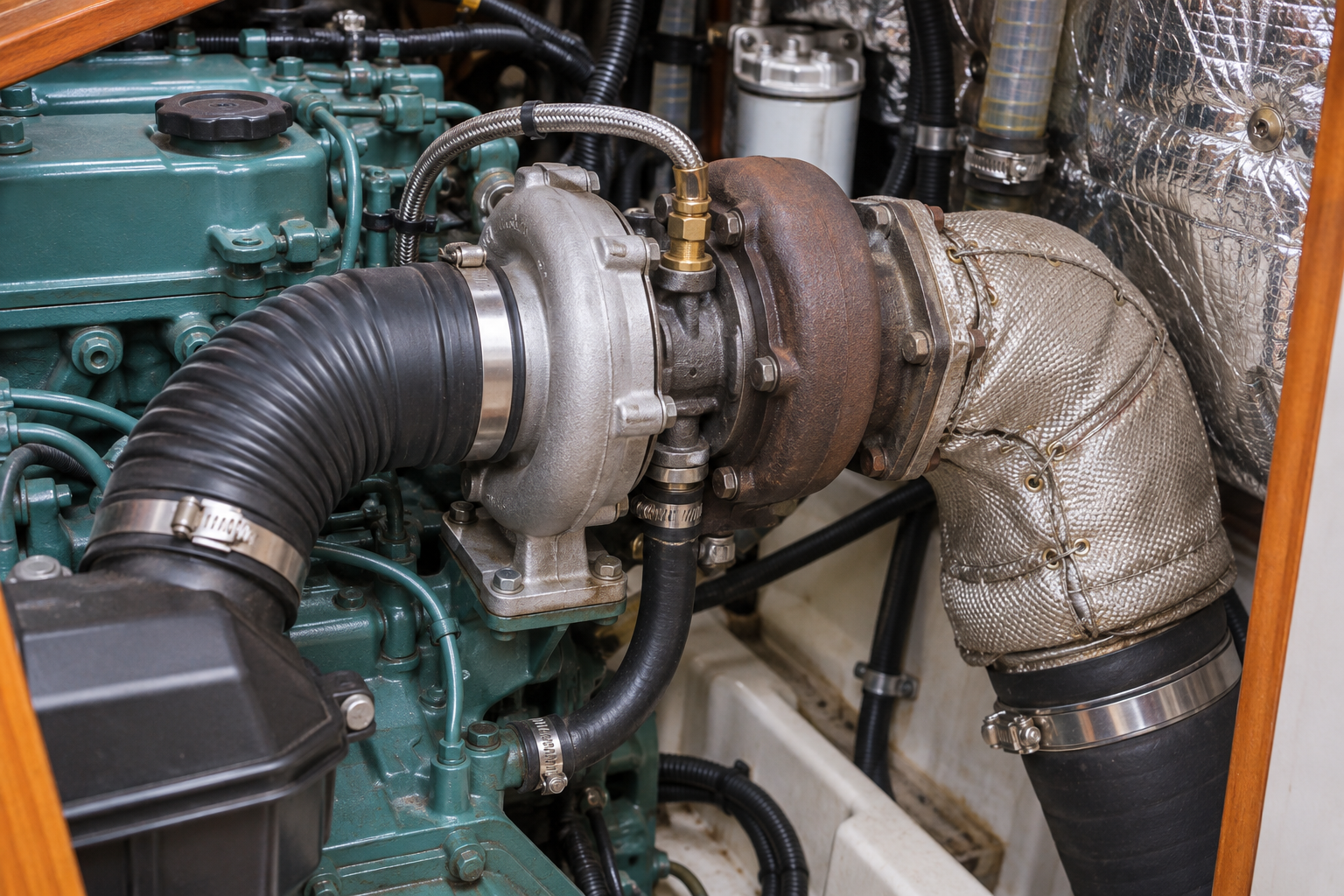
Document the adjacent systems
Record the engine and turbo identification along with when the symptom occurs. Inlet restriction, exhaust problems and other engine faults can share symptoms with a turbo fault. Let hot components cool and use model-specific service information for access and inspection.
What makes a report of lost power more actionable?
Include engine speed, load, alarms, smoke observations and the last maintenance, rather than naming a failed turbo from smoke or sound alone.
Step-by-step instructions
Verify whether the exact engine has a turbo
The Lombardini / Kohler LDW 502 marine conversion family may include naturally aspirated and turbocharged versions. Confirm the engine plate, serial-specific documentation, and visible factory configuration. Do not assume a turbo exists because another model in the same brand range has one.
Identify the configuration
First verify by model and serial number that the installed engine is actually turbocharged. Several common sailboat engines in this library are naturally aspirated and have no turbocharger.
Record symptoms and protect the engine
Record symptoms such as loss of power, unusual whine, smoke, oil consumption, leaks, or alarms. Avoid further operation if the turbo may be shedding oil or making mechanical contact.
Find the root cause
Have a qualified marine diesel technician diagnose oil supply and drain, intake restriction, exhaust backpressure, charge-air plumbing, and any cooler before condemning the turbo.
Match marine-specific parts
Match the replacement turbo and seals to the exact engine serial range and marine installation. Automotive turbochargers are not interchangeable with marine exhaust, cooling, and corrosion-protection arrangements.
Use qualified workshop procedures
Have removal, oil-circuit preparation, installation torque, actuator setup, and first-run commissioning performed from the engine maker’s workshop manual. Do not adjust a wastegate or fuel calibration by trial and error.
Commission and monitor
After repair, document the root cause, exact parts, and commissioning checks; stop the engine for overspeed, oil leakage, dense smoke, or abnormal noise.
Save service records
Keep the engine and turbo identifiers, technician report, replaced parts, root cause, and commissioning results with the maintenance log.
Safety note
Turbocharger work involves extreme heat and rotational speed. A wrong part, oil starvation, debris, incorrect actuator setup, or continued operation during failure can cause severe engine damage. This is an owner planning guide; use a qualified marine diesel technician for replacement and calibration.
Key takeaway
Verify turbo fit by engine serial number, correct the failure cause, and use a technician with the engine maker’s workshop procedure.
Manufacturer manuals and references
Use the latest documentation that matches the engine serial number and installed configuration.
Where to go next
- How to Change a Lombardini LDW 502 Fuel Filter
Detailed Lombardini / Kohler LDW 502 marine conversion fuel-filter replacement instructions, priming procedure, and post-service leak checks based on the engine maker’s manual.
- How to Prime a Lombardini / Kohler LDW 502 Marine Engine
How to prime and bleed the Lombardini / Kohler LDW 502 marine conversion low-pressure fuel system after filter service, fuel starvation, or fuel-system work.
- How to Replace a Lombardini / Kohler LDW 502 Alternator
A model-specific planning guide for replacing the Lombardini / Kohler LDW 502 marine conversion alternator, matching regulator and pulley, safely isolating the vessel, and checking the completed charging system.
Keep this job on your maintenance schedule
Save the topic as a maintenance task, choose a due date or engine-hour target, and record future service. Free and stored on your device.
Add to my maintenance plannerThis guide is for general education. Follow your equipment manufacturer’s instructions, current navigation guidance and applicable marine safety standards. When uncertain, use a qualified marine professional.