Before you start
Gather the appropriate supplies and review the specific equipment manual.
- Beta Marine engine identification details
- Operator’s maintenance manual
- Service log
- Flashlight
Build a service baseline
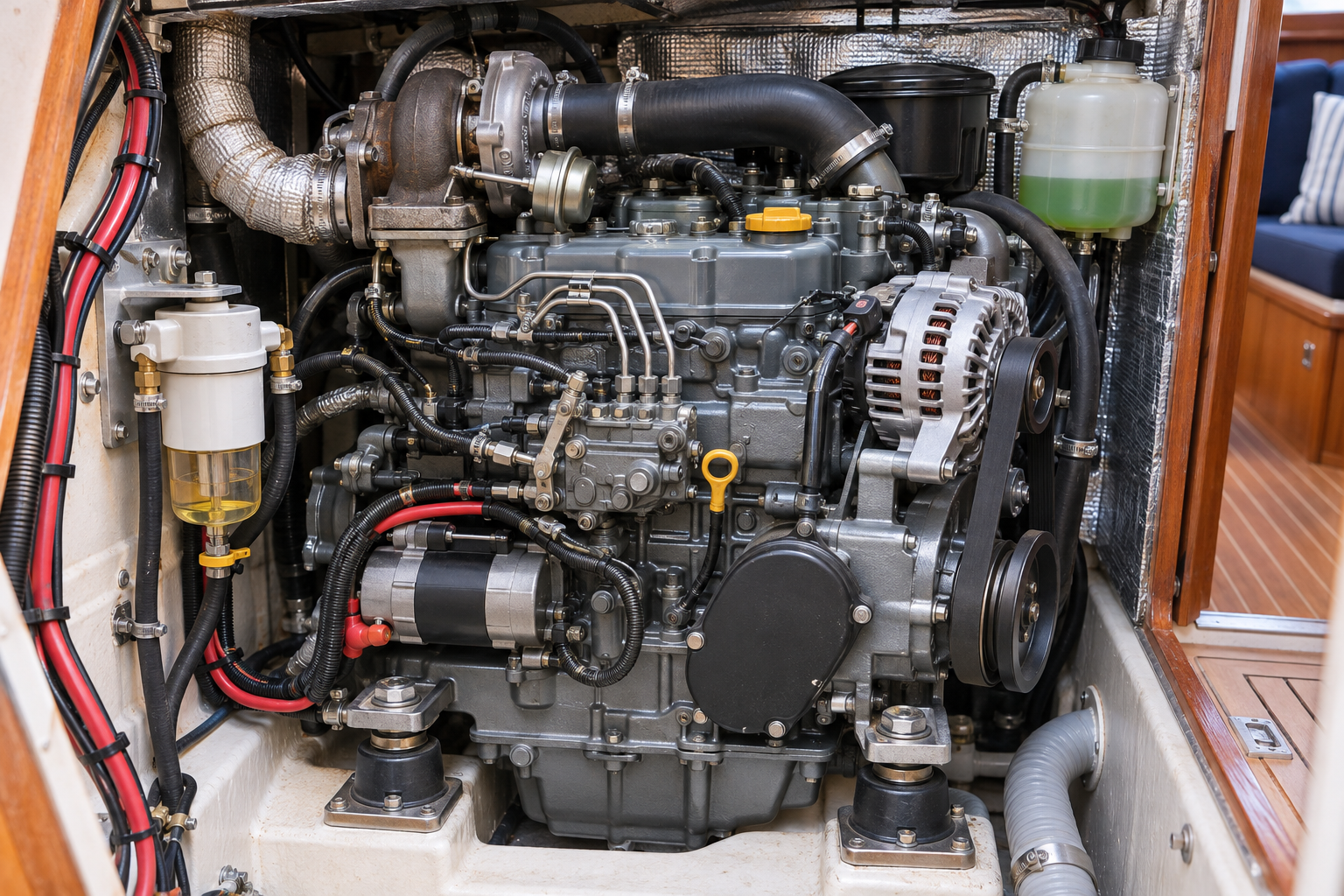
Photograph the identification plate and note the drive model separately. An engine family can span several serial ranges, and the gearbox can use a different lubricant from the engine. Match the manual and service parts to what is installed before ordering anything.
A seller says the engine was serviced last season. What evidence would help you plan the next job?
Ask for the date, engine hours, part numbers, fluid specification and technician’s notes. A date alone tells you little about use since the job. Record unknown items explicitly so that the next owner can distinguish a verified service from a verbal report.
Step-by-step instructions
Find out whether your engine has the shallow-sump option
Check the engine build information and installation records, or compare the sump arrangement with the Beta Marine manual. The shallow-sump option changes the sump shape and oil-pump connection. Do not infer the sump type from the boat model or from another Beta 60 installation.
Use the correct service schedule
Beta Marine states that its shallow-sump engines need an initial oil change after 50 hours, then annually or every 150 hours, whichever comes first. Follow the manual supplied with your engine if it gives a different schedule for your build, usage, or production revision.
Do not use the standard sump oil volume
Beta Marine notes that shallow-sump oil volumes are marginally reduced. Use the quantity in the matching operator’s manual rather than the standard-sump figure or a generic Beta 60 listing.
Use the dipstick marks for the installed engine
Beta Marine says the shallow-sump option retains the same dipstick calibration. Check the level with the procedure and boat attitude specified in the manual, and never add the reduced sump volume blindly as a refill amount.
Change the filter with the oil when scheduled
Beta Marine’s maintenance schedule includes changing the oil filter with engine oil at the service interval. Confirm the correct filter and installation procedure for your serial number, then check for leaks and verify the oil level after the post-service run.
Keep transmission service separate
The engine and gearbox may use different oil and intervals. Beta Marine directs owners to the supplied transmission operator’s manual for gearbox service. Do not drain or refill the gearbox as part of an engine-oil procedure unless its own manual calls for it.
Record hours and sump configuration
Write down the engine hours, service date, oil specification, quantity used, filter part number, and whether the engine is equipped with the shallow sump. This prevents the next owner or technician from applying the wrong interval or capacity.
Safety note
This guide is for the Beta Marine 60 shallow-sump option. Beta Marine’s shallow-sump interval and reduced oil volume do not apply automatically to standard-sump engines or other Beta models. Confirm the engine build and manual before servicing.
Key takeaway
On a Beta 60 with the shallow-sump option, the schedule and refill volume differ from the standard sump, while Beta Marine says the dipstick calibration remains unchanged.
Manufacturer manuals and references
Use the latest documentation that matches the engine serial number and installed configuration.
Where to go next
- Solé MINI-44 Sailboat Engine Service: 50, 250, and 500-Hour Checks
Use Solé’s MINI-44 maintenance packs to understand what is included at key service milestones, while checking the engine’s own manual for the actual interval and exact parts.
- Westerbeke and Universal Sailboat Diesel Oil Service
Plan an oil and filter change for Westerbeke and Universal marine diesels, identify the correct manual, and apply the manufacturer’s hours-or-season interval without guessing model specifications.
- Sailboat Diesel Turbocharger Inspection and Replacement Guide
Learn how to confirm whether a marine diesel is turbocharged, inspect common turbo symptoms, and plan a manual-led turbocharger replacement without damaging the engine or exhaust system.
Keep this job on your maintenance schedule
Save the topic as a maintenance task, choose a due date or engine-hour target, and record future service. Free and stored on your device.
Add to my maintenance plannerThis guide is for general education. Follow your equipment manufacturer’s instructions, current navigation guidance and applicable marine safety standards. When uncertain, use a qualified marine professional.