Before you start
Gather the appropriate supplies and review the specific equipment manual.
- Correct engine manual and serial number
- Specified filter and seals
- Fuel-safe catch pan and approved diesel waste container
- Eye protection, gloves, absorbent pads, lint-free cloths
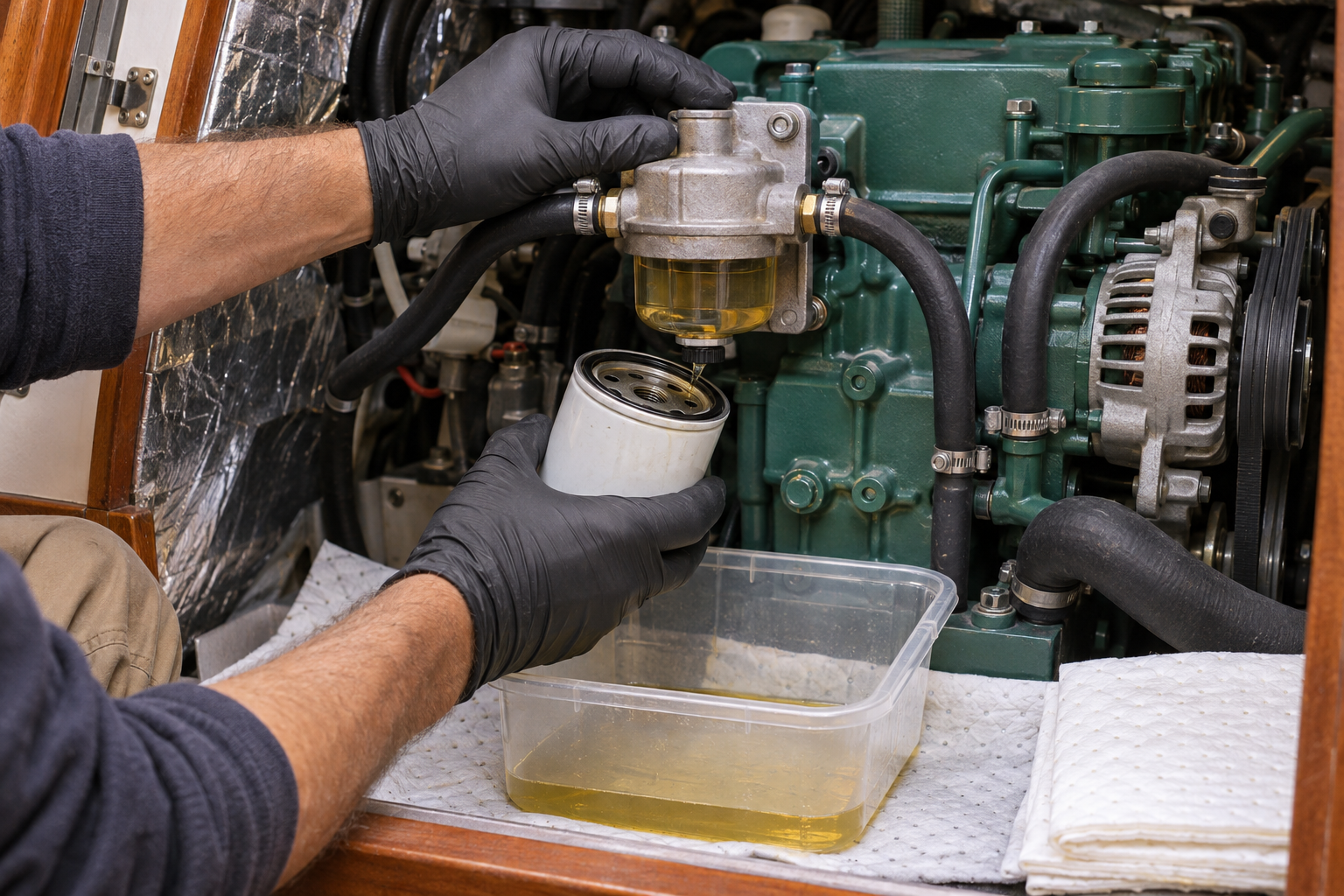
Match the filter and seal to the housing
Identify the primary separator and the engine-mounted filter in the service diagram. Record the exact filter element and seal references before removal. Fuel-system layout and priming procedures differ, especially between mechanical and common-rail engines. Follow the engine manual and leave high-pressure components to a qualified technician.
A starting problem appears immediately after a filter service. What should the service record show?
Which housing was opened, which element and seals were fitted, how priming was carried out and whether leakage was observed. Those details help separate a service-related problem from an unrelated starting fault.
Step-by-step instructions
Confirm engine version and fuel layout
This guide is for the Kubota-based marine conversion identified engine model. Read the engine and fuel-system identification plates and match the current operation manual to the serial range. Identify both the engine-mounted filter and any boat-installed water separator; these may use different elements, valves, and bleed points.
Prepare for a clean, contained service
Use the applicable fuel-safety procedure: cold stopped engine, ventilation, no sparks or flames, eye protection, absorbent pads, and approved waste container. Close the identified tank valve and clean the filter head before opening the system.
Remove the installed filter safely
Kubota supplies base engines to marine converters, but the converter supplies the marine fuel layout, filtration, controls, and sometimes different lift pumps. Record both the Kubota base-engine model and the marine engine maker/serial number.
Install the correct filter and seals
Use the conversion builder’s parts list to identify the engine filter and boat-installed primary separator. Follow its housing instructions, seal placement, shutoff steps, and whether a filter may be pre-filled; do not rely on a tractor procedure for a marinized engine.
Prime and bleed the low-pressure side
After fitting, use only the conversion manual’s low-pressure pump and bleed points. Check every disturbed hose and fitting for leaks before starting; never loosen injector pipes.
Check for leaks and log the work
Wipe the filter head and bleed point dry. Open the fuel valve, inspect before starting, then start only using the manual’s sequence. Stop immediately for seepage, rough running, or alarms. Dispose of fuel and filter waste responsibly and log the date, hours, part number, and findings.
Safety note
Do not bleed high-pressure injection lines. Diesel fuel can ignite on hot surfaces and can cause serious injury if injected under skin. If the identified low-pressure bleed point differs from the manual, stop and ask a qualified marine diesel technician.
Key takeaway
Use the fuel-system diagram and bleed point for the exact engine serial number; keep the low-pressure circuit clean and confirm leak-free operation.
Manufacturer manuals and references
Use the latest documentation that matches the engine serial number and installed configuration.
Where to go next
- How to Recognize Air in a Marine Diesel Fuel System
What to check when an engine is difficult to start just after a filter service.
- Yanmar JH-CR Fuel Filter Change and Fuel-System Priming
Model-aware instructions for replacing a Yanmar 3JH40, 4JH45, 4JH57, 4JH80, or 4JH110 fuel filter and bleeding air according to the JH-CR Operation Manual.
- Marine Diesel Fuel Filter Change and Fuel-System Priming Checklist
A safe, manual-led checklist for changing a sailboat diesel primary or engine-mounted fuel filter, restoring the fuel supply, and bleeding air without guessing at fittings.
Keep this job on your maintenance schedule
Save the topic as a maintenance task, choose a due date or engine-hour target, and record future service. Free and stored on your device.
Add to my maintenance plannerThis guide is for general education. Follow your equipment manufacturer’s instructions, current navigation guidance and applicable marine safety standards. When uncertain, use a qualified marine professional.